
The part of a long trip that trips people up isn't the packing — it's the admin they didn't do. Sort four things before you fly and almost nothing can go badly wrong at home while you're away: your money and cards, your documents, the things that keep charging you at home, and the person who knows where you are. None of it is exciting, all of it is quick, and every item on this list is something a traveller has genuinely wished they'd handled before they left.
- Keep a home bank account open and carry a backup card stored separately from your main one — a lost card abroad is an inconvenience, not a crisis, if there's a second one
- Check every passport in the party has enough validity left: many countries want six months beyond your travel dates, so an in-date passport isn't automatically an accepted one
- Direct debits, subscriptions and phone contracts keep taking money while you're away — cancel or pause what you won't use before you go, not after
- A GHIC covers state healthcare in some countries but is not travel insurance and won't fly you home — you want both
- Leave someone you trust your itinerary and copies of your documents; the government often can't share information about an adult without their consent
Money: one open account, one backup card
Start with money, because it's the one that turns a small problem into a stranded one. Keep a bank account open at home even if you're gone for a year — refunds, tax rebates and the odd bill still need somewhere to land, and closing everything down is a headache to reverse from abroad.
Carry at least two cards from different providers, and keep the backup somewhere separate from the one in your pocket — a different bag, ideally a different place entirely. If your main card is lost, cloned or swallowed by a machine, a second card is the difference between an annoying afternoon and being cashless in a country you just landed in.
Some banks still like to know you're travelling so they don't freeze a card that suddenly starts spending in Hanoi; many now detect it automatically. It costs nothing to tell them, and it's worth checking whether your card charges a fee on every foreign transaction before you rely on it.
Documents: the checks that stop you at the gate
Two document problems account for most people turned away at check-in, and both are avoidable the week before you fly.
The first is passport validity. An in-date passport is not automatically an accepted one — many countries require it to be valid for a set period beyond your travel dates, commonly six months, sometimes three. Check the rule for every country on your route, not just the first, and renew early if you're close, because processing takes time you may not have.
The second is visas and entry permits. Work out what you need well ahead — some are on arrival, some must be arranged before you travel, and the eligibility rules turn on your nationality and your age. Our working-holiday visa checker is a sensible place to start if a longer stay is the plan. Then take photos of your passport, insurance and key bookings, store them somewhere you can reach without your phone, and leave a copy with someone at home.
- Money
- Home account open · 2 cards · backup stored separately
- Passport
- Enough validity beyond your dates · renew early
- Visas
- Checked per country · arranged before travel if needed
- Insurance
- Bought when you booked, not the week you fly
- At home
- Direct debits + subscriptions paused or cancelled
- People
- Someone has your itinerary + document copies
If you're British, a free UK Global Health Insurance Card (GHIC) entitles you to medically necessary state healthcare in the EU and a handful of other countries, on the same terms as a local — genuinely useful, and it even covers pre-existing conditions. But it is not insurance: it won't cover private treatment, and crucially it won't pay to fly you home in an emergency, which is the single most expensive thing that can happen. You want both a GHIC and a proper policy, and the card never replaces the cover. Sort your travel insurance either way — outside GHIC countries it's the only thing standing between you and the full bill.
The stuff at home that keeps charging you
While you're away, home quietly keeps spending your money unless you stop it. Go through your bank statement line by line before you leave and deal with each recurring payment: cancel the gym you won't use, pause or downgrade the streaming services, and look hard at anything on an annual renewal that'll roll over mid-trip.
Your phone contract is usually the biggest one. Decide whether to keep paying for a UK plan you can't use, switch to a cheaper rolling tariff, or pause it — and sort your connectivity abroad separately, because an eSIM is almost always cheaper than roaming.
If you're leaving a rented place, sort the tenancy, and redirect or pause your post so nothing important piles up unseen. None of this is urgent enough to feel like it matters — until three months of forgotten subscriptions have quietly drained the budget you were saving for the trip.
The people who need to know where you are
This is the item people skip and later wish they hadn't, and it costs nothing.
Leave someone you trust a copy of your itinerary, your document photos and your insurance details, and agree — before you go — roughly how and how often you'll be in touch. It sounds fussy until you understand why it matters: if you're an adult, the government often cannot share information about you with your family without your consent, so a pre-agreed check-in is frequently the only backstop your family actually has. We wrote about that at length in our honest guide for worried parents, and it's the strongest argument for sorting this before you leave rather than assuming someone official will fill the gap.
Practical version: one person at home has your plans and your documents, you've agreed a check-in rhythm, and they know who to call if it goes quiet. That's it. It takes ten minutes and it's the cheapest insurance in this whole guide.
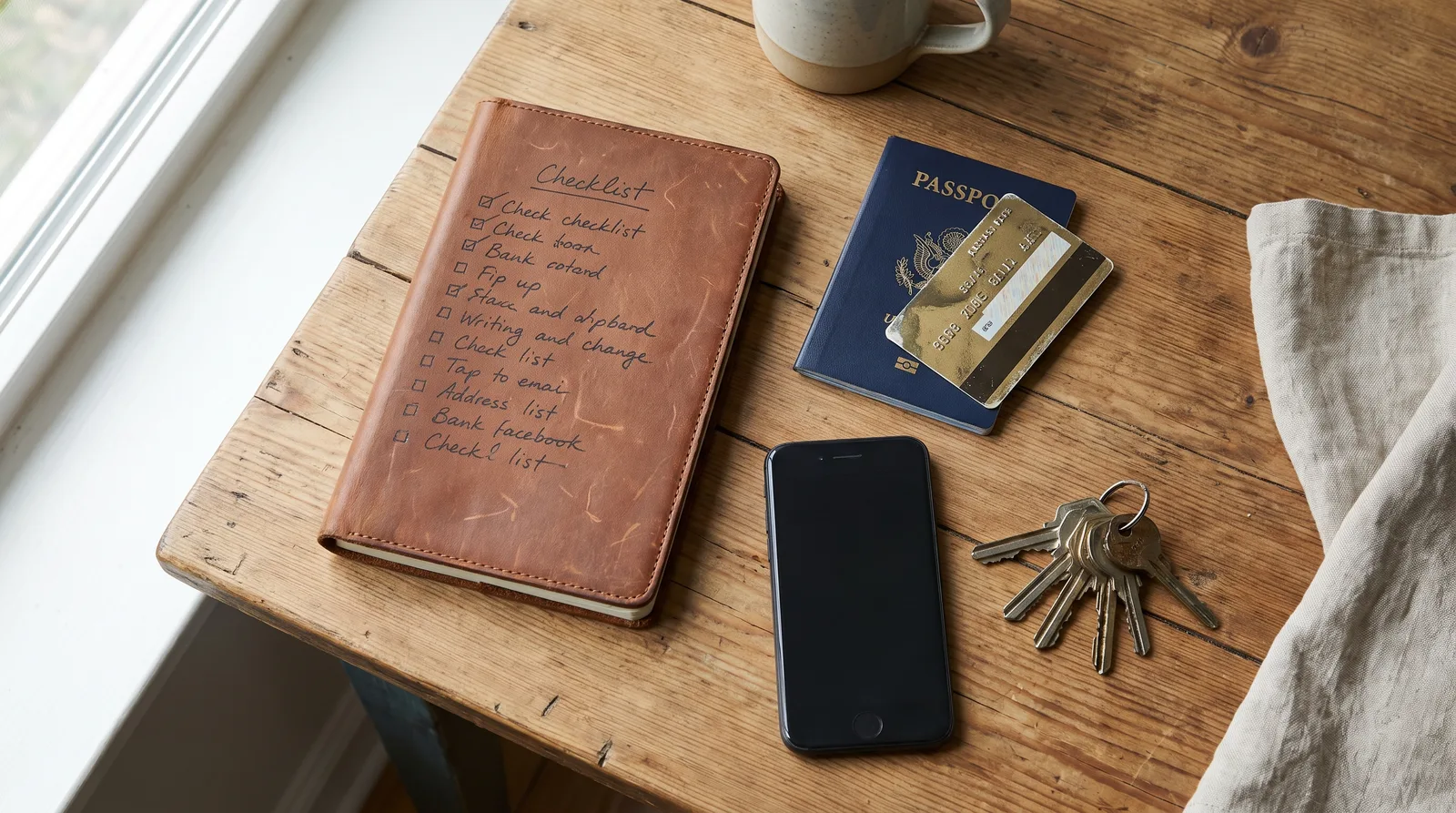
Health and prescriptions: the slow ones to start early
The health admin is worth starting weeks ahead, because the useful bits are the ones with lead times.
Get the routine things done at home while they're free or cheap — a dental check especially, since a filling that fails abroad is expensive and miserable. If you take regular medication, carry enough for the whole trip where you can, plus a copy of the prescription or a letter from your GP, because some everyday medicines are restricted or even banned in some countries and a letter is what smooths that over. Check that early, not at the airport.
Vaccinations and antimalarials need the most notice of anything on this list — some courses take weeks to complete — so book a travel-health appointment well before you fly. And if you take medication for a mental or physical health condition, declare it to your insurer honestly; an undeclared condition is one of the most common reasons a genuine claim gets refused.
Common questions
What admin should I do before a long trip?
Four things, in order of how badly they bite if skipped: sort your money (keep a home account open, carry a backup card stored separately), check your documents (passport validity per country, visas, digital copies), stop the payments that keep charging you at home (direct debits, subscriptions, phone contract), and make sure one trusted person has your itinerary and document copies. Everything else is detail on top of those four.
Do I need to tell my bank I'm going travelling?
Often no longer strictly necessary — many banks detect foreign spending automatically — but it costs nothing and avoids a card being frozen mid-trip, so it's worth a quick call or a note in the app. More important is carrying a second card from a different provider, kept separately, and checking whether your card charges a fee on every foreign transaction before you depend on it abroad.
How much passport validity do I need?
More than just 'in date'. Many countries require your passport to be valid for a period beyond your travel dates — commonly six months, sometimes three — and will turn you away at check-in if it isn't, even though the passport hasn't technically expired. Check the specific rule for every country on your route, and renew early if you're anywhere close, because renewals take time you might not have before departure.
Is a GHIC enough, or do I still need travel insurance?
You need both. A UK GHIC gives British travellers medically necessary state healthcare in the EU and some other countries on the same terms as a local, including for pre-existing conditions — but it is not insurance. It won't cover private treatment, and it won't pay to fly you home in an emergency, which is the biggest cost of all. Outside GHIC countries it does nothing, so a proper policy is the thing you actually rely on.
What's the one job people most regret skipping?
Leaving someone their plans. Because a government often can't share information about an adult without that adult's consent, a pre-agreed check-in with someone at home is frequently the only real backstop your family has if something goes wrong. It takes ten minutes — your itinerary, copies of your documents, and an agreed rhythm for staying in touch — and it's the cheapest and most valuable item on the whole list.

Nadia covers the part of long-term travel that happens at a desk — whether you can actually get your job back, what a year away does to your state pension and social-security record, how student loans behave once you leave the country, and what nobody warns you about coming home. The rules differ by where you're from, so every figure is quoted from the government source that sets it, for the country it applies to, with the date it was checked — and where a rule only holds in one country, it says so.