
Most travel tech is dead weight you carry for the one day you might use it. The kit that genuinely earns its place is short: one decent power bank, one universal adapter, your phone doing the work of three gadgets, and a bag that survives being thrown around. The thing most likely to actually catch you out in 2026 isn't what you packed — it's the new power bank rules, which changed in March and are now enforced at the gate.
- New international rules took effect on 27 March 2026: power banks must stay in the cabin, many airlines now cap you at two, and charging them mid-flight is increasingly banned
- A power bank up to 100Wh (roughly 27,000mAh) is fine; 101–160Wh needs airline approval; above 160Wh is banned outright — and none may ever go in checked luggage
- For most travellers a phone replaces a camera, a torch, a map and an e-reader — a separate camera only earns its space if you'll genuinely use it
- Buy for durability and how it packs, not spec sheets — the cheap option often wins, and the flashy one is usually the first thing you regret carrying
- The single most useful upgrade for staying connected isn't a gadget at all — it's an eSIM sorted before you fly
Start by cutting, not buying
The honest starting point for travel tech is subtraction. Every gadget forum wants to sell you a bag full of accessories; the reality on a long trip is that you carry most of them unused, charge them out of guilt, and resent the weight by week two.
The test I apply to everything is simple: does this earn its bag space on an ordinary day, not the imagined perfect one? A drone earns its space if you fly it weekly, not if it comes out twice and spends the rest of the trip as a brick you're afraid of losing. A laptop earns its space if you actually work; if you're checking email, your phone does that.
So before the list of what to bring, the more valuable list is what to leave. Almost everyone over-packs tech and under-packs the two things that matter: power and a bag that lasts.
Power: one good bank, and the rule that just changed
One power bank, chosen well, beats three chosen cheaply. The number that matters is capacity, measured in milliamp-hours (mAh) or, on the label the airlines care about, watt-hours (Wh). A 20,000mAh bank — around 74Wh — will recharge a phone three or four times and is the sweet spot for most trips: enough for a long travel day, small enough to forget about.
Here is the part that genuinely catches people out in 2026, and it's new. Power banks have always had to travel in your carry-on, never in checked luggage, because the hold is unmonitored and a lithium fire there is far more dangerous. But as of this year the rules tightened sharply, and they're being enforced at the gate rather than waved through.
Check your own airline before you fly — the limits now vary by carrier, and "it was fine last year" is no longer a safe assumption.
- Up to 100Wh (~27,000mAh)
- Carry-on, no approval needed
- 101–160Wh
- Carry-on + airline approval, max 2
- Over 160Wh
- Banned from passenger flights
- Checked luggage
- Never — cabin only
- In the cabin
- Keep visible, not in the overhead bin
- Charging mid-flight
- Increasingly banned — check your airline
New international standards approved through the UN's aviation body (ICAO) took effect on 27 March 2026 and apply across its member states. The headline changes: power banks must stay within reach in the cabin rather than in the overhead bin, so crew can get to one that overheats; a growing list of airlines now limits you to two power banks (some, like Southwest, to one); and charging a power bank from an in-seat USB port — or using it to charge your phone during taxi, take-off and landing — is being prohibited. Airlines are applying this at different speeds and some go further than the baseline, so the only reliable move is to check your specific carrier's current policy the week you fly.
Charging everything else: one adapter, fewer cables
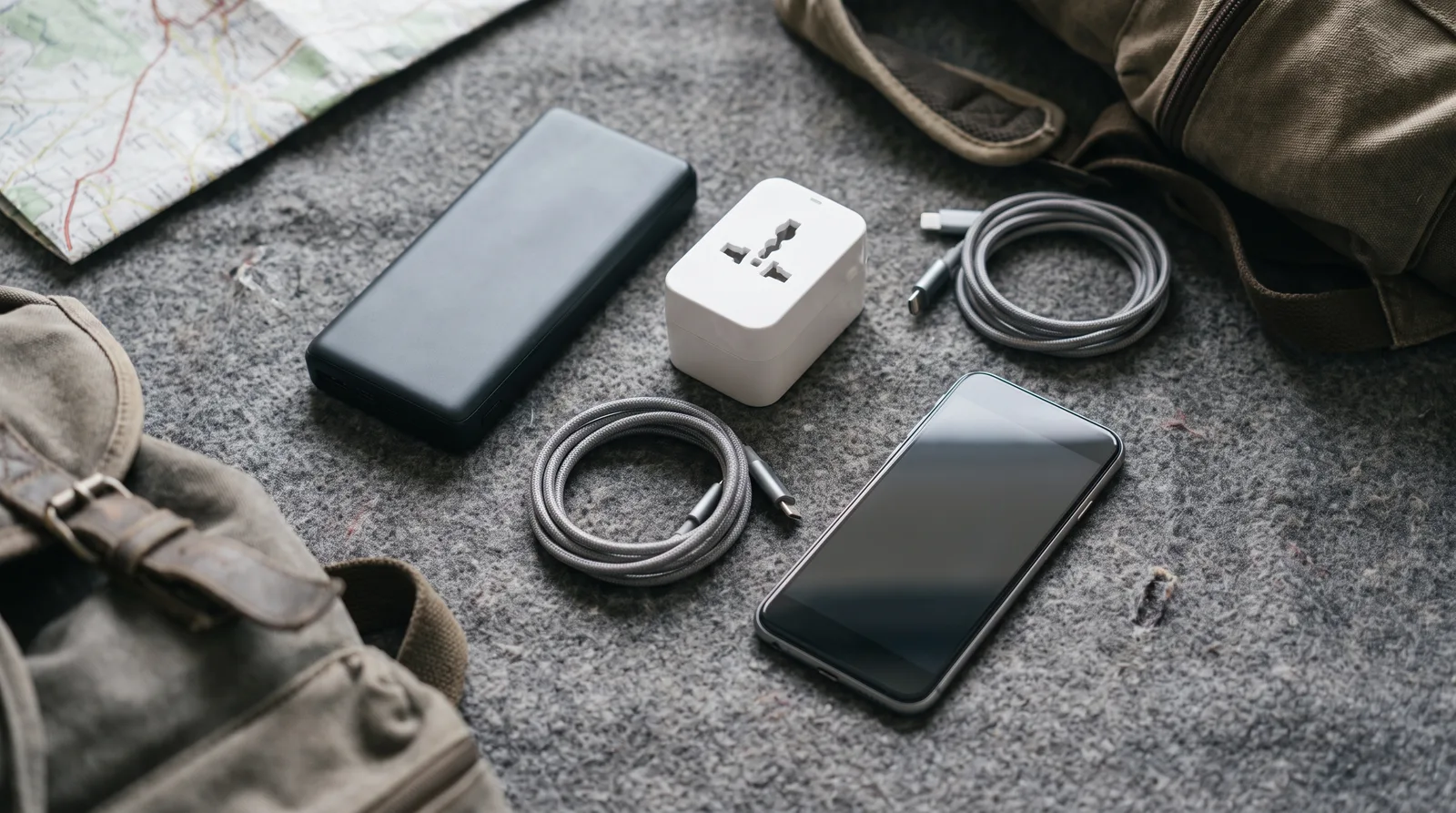
After the power bank, the highest-value item in the bag is a single good universal travel adapter — one that covers UK, EU, US and Australian sockets, ideally with a couple of USB ports built in so it charges the bank and the phone from one wall socket. It replaces the drawer of country-specific plugs people still buy in airports.
Pair it with one compact multi-port charger rather than a separate brick per device. Modern gallium-nitride (GaN) chargers are noticeably smaller and lighter than the old white bricks for the same output, which is the rare case where the newer tech genuinely earns the upgrade.
Then be ruthless about cables. Two good braided cables that fit everything you own beats a nest of six thin ones, and braided outlasts moulded rubber, which frays at the connector within a season of being stuffed in a daypack.
Staying connected without a gadget
The best connectivity upgrade isn't hardware. It's an eSIM bought and installed before you leave, so you land with working data instead of hunting a SIM kiosk while jet-lagged and haggling in a currency you can't yet feel. Most phones from the last few years support it, and it sidesteps the physical-SIM shuffle entirely — worth reading up on how the trade-off works, because it isn't always the cheapest option, just usually the least painful. See our take on eSIM versus a local SIM.
Beyond that, the useful "gear" is free and lives on the phone you already carry: offline maps downloaded before you go, your accommodation and tickets saved offline, and a translation app with the local language pre-downloaded. None of it weighs anything, and all of it works when the signal doesn't.
Camera or phone? Be honest with yourself
This is where people spend the most and regret it the most. A modern phone camera is genuinely excellent, always in your pocket, and backs up automatically. For the large majority of travellers it is the only camera worth carrying, and a dedicated camera spends the trip in the bag as expensive ballast.
A separate camera earns its space in a narrow set of cases: you shoot in low light a lot, you want proper zoom for wildlife, you're actually making content rather than posting it, or photography is a real part of why you travel. If one of those is true, a compact mirrorless or a rugged compact is worth it — but buy for how it handles being carried daily, weather-sealing and battery life, not for the megapixel number on the box.
If you're unsure which camp you're in, you're in the phone camp. The people who need the camera never have to ask.
The bag is the gadget that matters most
The most important piece of tech on this list has no battery. A bag that survives being thrown onto buses, rained on and over-stuffed for months does more for your trip than any gadget, and it's the one thing genuinely worth spending on.
The criteria that matter: it fits airline carry-on dimensions so you never check it, the zips and straps are heavy-duty because those are what fail first, it opens like a suitcase rather than a top-loading sack so you can actually find things, and it's comfortable loaded — hip belt, structured back — because you'll wear it for hours. Brand and colour are irrelevant; a bag that lasts three trips is cheaper than three bags that each last one, which is the whole cheap-versus-flashy point in one object.
The gear that quietly over-delivers is dull: a 20,000mAh power bank, a USB universal adapter, one GaN charger, two braided cables, an eSIM, and a carry-on-sized backpack with good zips. The gear that under-delivers for the money is almost always the exciting stuff — the drone you fly twice, the action camera that duplicates your phone, the smartwatch you charge nightly for features you don't use travelling. Spend on the boring things that never let you down, and be suspicious of anything marketed as essential.
Common questions
Can I take a power bank on a plane in 2026?
Yes, in your carry-on — never in checked luggage. A power bank up to 100Wh (roughly 27,000mAh) needs no approval; 101–160Wh needs the airline's sign-off and you're limited to two; above 160Wh is banned. Since March 2026 many airlines also require it to stay within reach rather than in the overhead bin, cap you at two banks, and prohibit charging it mid-flight. The limits vary by carrier now, so check yours the week you fly.
What size power bank should I actually buy?
Around 20,000mAh (about 74Wh) is the sweet spot for most trips — three or four full phone charges, comfortably under every airline limit, and small enough to forget about. Going bigger mostly adds weight and edges you toward the approval threshold. If you're powering a laptop or camera batteries too, look at capacity and how many devices it charges at once rather than the headline number alone.
Do I need a proper camera or is my phone enough?
For most travellers the phone is enough, and a separate camera becomes expensive ballast. A dedicated camera only earns its space if you shoot low light often, want real zoom, are genuinely creating content, or photography is part of why you travel. If you're not sure, that's your answer — the phone. Buy a camera for durability, weather-sealing and battery life, not the megapixel count.
What travel tech is a waste of money?
Anything you carry for the imagined perfect day rather than an ordinary one. The usual regrets are drones (flown twice), action cameras that duplicate your phone, a laptop you brought "just in case", and country-specific plug adapters when one universal adapter does the lot. The reliable rule: spend on the boring, durable essentials and be suspicious of anything sold as a must-have gadget.
What's the one upgrade worth making before I fly?
Sort an eSIM. It's not hardware and it weighs nothing, but landing with working data instead of hunting a SIM kiosk jet-lagged is the single biggest quality-of-life difference on arrival. Pair it with offline maps, offline tickets and a pre-downloaded translation app, and your phone quietly replaces half the gadgets people pack.

Riley covers the tech side of travelling — the gadgets, cameras, power banks, apps and gear that actually earn their place in your bag. Reviews are hands-on and criteria-led, weighing durability and real-trip use over spec sheets, and Riley is quick to say when the cheap option beats the flashy one.